Unlike vane pumps, which vane extension is important and against which
the pressure acts to generate the rotation, the Quasiturbine contour seals have an
imperceptible extension and the rotation does not result from pressure against these seals.
Since the cylindrical (or oval) stator of vane devices has a radius of curvature
greater than the rotor, the two surfaces (rotor - stator) cannot reach a close
fit at top dead center (TDC), while the surfaces of both the rotor and stator of
the Quasiturbine fit exactly against one another to produce a high compression
ratio. This is why QT is efficient (less pressure charging losses), and this is why there is no vane combustion engine.
Quasiturbine publishes « efficiency data ».
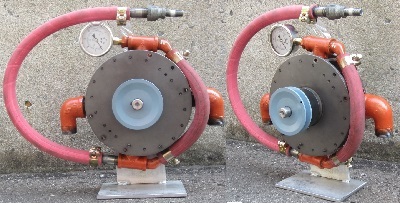
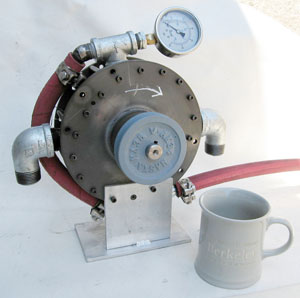
QT.6LSC (shown here) without the differential and the central shaft.
Quasiturbine Model QT.6LSC has a volume of 75 cc per chamber,
and swept 8 chambers per revolution (4 on the top, 4 on the bottom),
which totalized 600 cc per revolution.
Quasiturbine Uniflow Characteristic
In most reciprocating piston engines, the steam reverses
its direction of flow at each stroke (counter-flow). By entering and
exhausting the cylinder by the same port, the cylinder valve and walls are
cooled by the passing exhaust steam, while the hotter incoming admission
steam is wasting some of its energy in restoring the temperature. Some
energy is further lost in reversing the motion momentum of the mass of
steam within the piston. The aim
of the piston uni(directional)flow
is to remedy this defect by providing an exhaust
port at the end of the stroke, making the steam flowing only in one
direction, but has the inconvenience of recompressing some residual
cylinder steam. Quasiturbine is a uniflow engine, with the further
advantage of not recompressing any residual steam, resulting in superior
energy efficiency. Recompressing residual steam means some reversibility
losses, and the pressure increases makes a substantial restriction to the
initial steam flow into the chamber, not to ignore the truncated cycle
near bottom dead center - None of this with the Quasiturbine.
QT.6LSC Steam (gas) 1.5 kW
QT.6LSC Product Description
The Steam Quasiturbine unit is very
similar to the pneumatic one, except for thermal dilatation provision,
lubrication and corrosion consideration.
Each chamber has a 75 cc maximum volume, and the motor expands 8 chambers per revolution:
Displacement: Total = 8 x 75 cc = 600 cc intake per
revolution.
Intake Volumetric Flow Rate = Engine displacement x RPM
Cylindrical outside about 8" (~20.3 cm) in diameter excluding peripherals.
Thickness 2,5" (~6,4 cm) excluding shaft and peripherals.
The casing and rotor are made of metal (no aluminum at this time).
Power shaft: 3/4-inch (~1,9 cm) diameter throughout.
2 intake ports 1/2"
male NPT pipe threads.
2 exhaust ports 1"
male NPT pipe threads.
Weight (all metal) about 20 pounds (9 Kg).
Simple in-line lubrication.
Silencer is not provided.
Not optimized as compressor.
Present typical limitations under proper lubrication:
- Intake pressure: 60 psi (4 bar) peak.
- Revolution: 600 rpm.
- Block temperature: Under 150 °C (300 °F) (steam can be hotter?)
- Torque (2009 version and later):
Up to
30 N-m (25 pound-foot) peak (with no step down gearbox).
- Power 1,5 kW (2 HP) peak
- Pressure-flow energy conversion: +/- 80 % of theoretical single-stage
(optimum across the range - no off-peak penalty)
Maximum Temperature Control:
Provision for thermal expansion is for now limited
to a rotor temperature of 150 C (300 F). This is
generally not a concern with a water saturated steam
source up to 60 psi.
Hydraulic and Condensate : It is best to remove the
condensate in the steam line before starting and continuously if necessary (This
could increase the overall system energy efficiency). This steam Quasiturbine can
handle saturated steam, but it must not be use with incompressible fluid (liquid hydraulic mode) -
When possible, avoid excessive internal liquid condensation and do not flowed
with lubricant. This unit can however be used in pneumatic mode.
Quasiturbine Model QT.6LSC Steam
Usable with intake pressure from 1 to 60 psi (4 bar) peak!
Not being
mass produced, Quasiturbines are like precious « Ferrari », while the «
energy cost » to run less efficient equipments may lead to no overall saving.
Among the new emerging technologies like
hybrids, hydrogen, fuel cell, PV solar, in-wheel motor, power windmill, nuclear thermal...
the Quasiturbine is by far the least expensive innovation to familiarize with!
QT.6LSC
Typical Characteristics
QT5LSC theoretical main characteristics can be approximated from 3 parameters:
Instantaneous maximum
torque for 2 opposed working chambers is
= 8 + 8 = 16 N-m / bar (0.4 + 0.4 = 0.8 pound-foot / psi).
The average torque is 65 % of the instantaneous maximum,
which is 10,4 N-m / bar (0.5 pound-foot / psi) differential effective
pressure through the motor, assuming no truncated intake);
The RPM revolution within reasonable range up to 600 rpm and the Intake
Volumetric Flow Rate up to 0,3 m3/min. (75 cc
x 8 chambers per revolution x rpm, assuming no truncated intake);
The power output up to 1,5 kW peak, which is proportional to the product: Torque X rpm.
Typical value given as indication only. May vary from one QT to another.
QT.6LSC
Steam characteristics are roughly similar to the Air Motor.
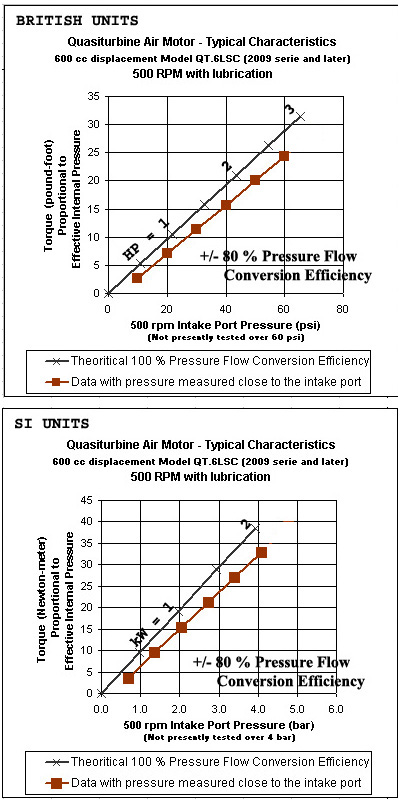
This graph is from a QT.6LSC Air Motor
at 500 rpm and up to 60 psi (4 bar), and is given as an indication.
Perfect « single-stage theoretical expander curve » is shown for
comparison. Ratio of the 2 curves is +/- 80%
(optimum across the range - no off-peak penalty)
Steam consumption: For most positive displacement engine,
the Intake Volumetric Flow Rate is the displacement time the rpm,
which gives for the QT.6LSC:
= 600 cc x 500 rpm = 0,3 cubic meter per minute.
QT reacts to gas or steam volume (not mass) given as the
« Intake Volumetric Flow Rate - IVFR » which depend only of
displacement and rpm, not of pressure, nor of power. At higher power,
pressure is higher and mass flow is higher, but the Volumetric Flow stay unchanged.
Efficiency reminder: Specific steam flow in kg/kW-h
is not a comparison efficiency criteria between different turbines,
because there is much less energy invested in 1 kg of steam at 4 bar and
150 C, that there is in 1 kg of steam at 30 bar and 300 C. For efficiency
comparison, one must look at the turbine energy output versus the energy
content within the kg of steam?
Theoretical Output Power Extrapolation: Pressure increases
both the rpm and the torque. Since the power is proportional to the product of rpm
X torque, the power output is roughly proportional to the square of
the pressure. Increasing the pressure by 3 fold would then increase
the power by 9 times! (2 kW at 4 bar would theoretically become 18
kW at 12 bar - or - 3 HP at 60 psi would theoretically become 28 HP at
200 psi). This is of course outside the operational range of the present
machines...
Expander Efficiency
Expanders expand the gas of a reservoir, but not necessarily the gas within the expander.
The efficiency is a ratio expressed in %. It is used to evaluate an
equipment result in relation to either the incoming energy (Semi absolute
efficiency - when for example for gasoline engine: energy extraction,
transportation and refining are discarded), either in relation to a partial form of
energy (relative efficiency), or in relation to the result of an other
equipment or reference theory (comparative efficiency). To further
complicate the situation, different engines with same efficiency on bench
test will lead to different efficiency applications (in mobility for example,
due to weight and gearbox
requirement). No correct efficiency interpretation is possible without
knowing detail calculation. Consequently, it is
not possible to optimized simultaneously an expander for maximum power and
maximum efficiency, a choice must be done.
The efficiency is generally in relation to the task an equipment is
attempting to accomplish, and in the present context all « single-stage
expanders » can conveniently be compared to the « single-stage expander
theoretical model (without intake cut-off) », which is simply a piston
making work under pressure, while moving in an infinitely long cylinder
(which is a useful reference):
Theoretical Single Stage (TSS) Calculation:
British units: (See theoretical line on the British units graph)
Power (HP) = Pressure (psi) X Volumetric Flow Rate (VFRcfm) / 229
(As an example: 1 HP = 7.63 VFRcfm at 30 psi) Metric units: (See theoretical line on the SI units graph)
Power (kW) = Pressure (bar) X Volumetric Flow Rate (VFRm3/min.) X 1.70
(As an example: 1 kW = 0.29 VFRm3/min at 2 bar)
Devices are not all equally efficient when attempting to match
this theoretical piston-cylinder model, but Quasiturbine does it (with no
intake cut-off) at +/- 80
% of the perfect theoretical single-stage (with potential improvements up
to 95 %). To reach such a level of comparative efficiency, other concepts
need to run at nominal power only, or to use intake cut-off techniques. Such techniques are adaptable to
the Quasiturbine as well, for an overall top performance.
Note: There is more intrinsic energy in the compressible incoming flow
(energy accumulating in the infinitely long cylinder as the piston moves)
that single-stage expanders are not attempting to recover (it is not
within their tasks), and which end up in the exhaust. Additional recovery
would require cut-off intake valve and multi-stages (QT?) expanders, but
at a much reduced machine specific power density (larger expander and
higher cost).
Selecting a high efficiency engine is a good start, but other system
components and thermodynamic cycles also impact the global system
efficiency, which should not be confused with the engine component efficiency.
Comparing Quasiturbine to Vane Motor
Since the cylindrical (or oval) stator of vane devices has a radius
of curvature greater than the rotor, the two surfaces
(rotor - stator) cannot reach a close fit at top dead
center (TDC), while the surfaces of both the rotor and
stator of the Quasiturbine fit exactly against one
another to produce a high compression ratio. This is
why QT is efficient (less pressure charging losses).
Several manufacturers are offering quality products based on Vane Motor concept.
As a matter of preliminary comparison (assuming intake pressure near the
effective internal pressure), here are some typical data of
Quasiturbine versus a GAST air product (calculated
under same running pressure):
Quasiturbine QT.6LSC under 4 bar (59 psi) and 500 rpm: 1.7 kW // 2.3 HP
Detail:
quasiturbine.promci.qc.ca/EProductQT75SCPneumatic.htm
Intake Volumetric Flow Rate (IVFR) = 0.3 IVFRm3/min // 10.6 IVFRcfm
Effective Displacement: 0.3 IVFRm3/min / 500 rpm = 600 cc // 36.6 po3 per revolution
Consumption: Free air* = 1.5 m3/min of free air // 53 cfm of free air
(* Estimated at 4 bar (59 psi) as 5 times the IVFR of 0.3 m3/min). Consumption Specific = 0.88 m3/min-kW of free air // 23 cf/min-HP of free air
Theoretical Single Stage Power (TSS) = 4 bar X 0.3 m3/min X 1.70 = 2.04 kW
Theoretical Single Stage Power (TSS) = 59 psi X 10.6 IVFRcfm / 229 = 2.74 HP QT Performance: 1.7 kW / 2.04 kW = 2.3 HP / 2.74 HP = 83 % of TSS
GAST 4AM Vane motor under 7 bar (103 psi) and 3000 rpm: 1.3 kW // 1.7 HP
Detail:
www.gastmfg.com/pdf/airmotor/specsht/4AM.pdf
(Notice that this motor accepts air only - no steam)
Intake Volumetric Flow Rate (IVFR)* = 0.25 IVFRm3/min // 9.2 IVFRcfm
(* Estimated at 7 bar (103 psi) as 8 times less
the flow of 2.0 m3 free air /min).
Effective displacement: 0.25 IVFRm3/min / 3000 rpm = 83 cc // 5.1 po3 per revolution
Consumption: Free air = 2 m3 free air /min // 70 cfm of free air Consumption Specific = 1.53 m3 free air /min-kW // 41 cf/min-HP of free air
Theoretical Single Stage Power (TSS) = 7 bar X 0.25 X 1.70 = 3.0 kW
Theoretical Single Stage Power (TSS) = 103 psi X 9.2 / 229 = 4.0 HP GAST Performance: 1.3 kW / 3.0 kW = 1.7 HP / 4.0 HP = 43 % of TSS
From the energy reversibility (heat lost) point of view, the
difference is even greater, as one consumes its air
volume at 7 bar (100 psi), while the QT consumes it at
only 4 bar (60 psi).
In conclusion, the Quasiturbine concept (without intake cut-off)
operates at 80 % of the Theoretical Single Stage
(TSS) Power, compared to 40 % for Vane Motor concept
(even when using some intake cut-off saving), with
QT potential to reaches 95 % under high mechanical
tolerances. Furthermore, QT operates in the most demanding conditions of
high displacement, low pressure and high torque.
Consequently, the Quasiturbine air/steam concept
exceeds substantially the relative efficiency of
Vane Motor concepts, which is consistent with the
vane loading chamber volume lost. For many
applications, there is little or no benefit to use
vane air motor when the pressured fluid
consumption is the dominant cost factor.
QT Steam Lubrication
As for piston steam engine, periodic oil needs
to be injected into the motor intakes steam flow. One possibility is oil injection within one of
the intake port using a small pulsed pump (electrical or pneumatic). An
other more simple way is to keep an oil reservoir pressurized (with air?)
slightly over the QT intake pressure, and to simply control the oil flow
through a needle valve.
The grade of recommended steam
cylinder oil for these conditions is ISO 460 which contains 4% tallow oil.
This is the grade of oil that the “ride-on” locomotive community uses. It
is generally available in 5 gallons, but Sulphur Springs Steam Models
sales@sssmodels.com
provides it in quart cans. Chevron USA has a relatively new steam cylinder
oil on the market that is lighter in viscosity than ISO 460 by about half
(1103 SUS vs. 2335 SUS @ 100 F). Other steam oil may do as well, search "
steam cylinder oil" on the web for local suppliers. It does
not require much oil, and it can be re-circulated.
Never use motor oil or inappropriate lubricant.
Never use oil with additive like antifriction,
because large air flow or steam oxidized the oil and precipitate the
additives in « glue like product », as it
will oxidize and degrade into solid or viscous material under steam
contact. If this happen, attempt cleaning the engine with a glass of
kerosene in the intake, while turning the engine slowly by hand. Re-oil
properly.
Feed Line Capacity
Flow velocity near a
piston valve is always impressive, and it is not
different with the Quasiturbine intake ports. To
sustain 500 rpm in a 600 cc displacement QT.6LSC,
the intake flow rate must be (600 cc X 500 rpm) =
0.3 m3 / min.. Knowing that a 1/2 inch
diam. tubing contains 0.125 litre / meter long, this
correspond to a flow velocity in the tube of :
(300 litres / min.) / (0.125 litre / m) =
40 m / s or 150 km / h Could be half, considering
that the Quasiturbine has 2 intakes which could be
feed individually. Velocity near the intake ports
will be even higher. Consequently, such a relatively
small tubing must be quite short (or act as a
limiting safety factor to protect the unit?). Notice
that once the pressurized fluid gets into the
engine, the flow velocity reduces to match the
tangential rotor speed, which is: (engine
perimeter = 50 cm) X 500 rpm = 4 m / s = 15 km / h
and flow speed increases again into the exhaust,
which must show minimum restriction.
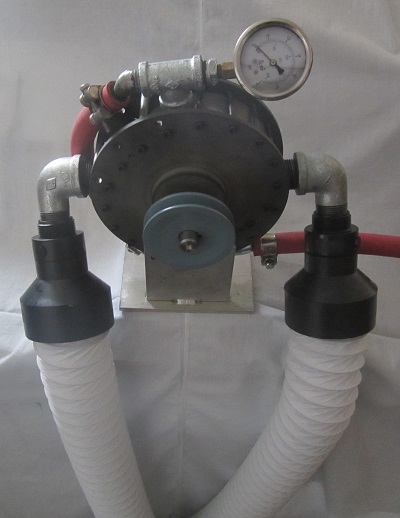
Good example of minimum exhaust flow restriction
after air expansion (few meters).
This preserves pressure differential and full power of the QT.
An appropriate steam condenser close to the exhaust port
could also be a valid solution.
Across an expander, the mass flow stays constant,
but the volumetric flow does not.
A good set-up require a
short and generous size feed line and exhaust line.
Sealing the Quasiturbine
As delivered, the Quasiturbine has no pretention to
be a sealed machine, and in particularly at the shaft bearings.
Because Quasiturbine can be used with a multitude of
gases (some environmentally sensitive), and
considering the multitude of seals available, it is
up to the owner to apply if
needed, its proper sealing solution to the system
(Look in Search Engine Image for «
Axial Radial Shaft Seal » or «
Replacement Cartridge Mechanical Seal »). Some seals cost less that 10 $ to buy,
but high temperature seal could cost more.
General info at
www.skf.com/files/889495.pdf .
While thin wall enclosure is an ultimate solution
for critical situation, stuffing
box (made of a simple outside washer bolted to the
engine block) with Graphite Coating Packing Sealants
could often be an acceptable straight forward
solution.
Quasiturbine model QT.6LSC Steam (1,5 kW peak)
with rotating central differential and shaft,
is intended for integration research, demonstration and projects.
To be used only under competent supervision.
Guaranty is limited to replacement (pick-up) of defective parts.
Sale done FOB Montréal, Québec Canada
No Canadian local sale taxes on export.
Not including the shipping (pick-up)
and custom fees
(NAFTA Exempted?) H.S. # 8413.81:
3900.00 US$
Money rate conversion at
http://fr.finance.yahoo.com/m3
Package: Weight: 14 kg / 30 pounds.
Size: 30 cm X 30 cm X 26 cm high / 12 X 12 X 10 inches height.
Email the form to
info@quasiturbine.com or fax to 514-527-8484.
An invoice will follows with payment instructions.
(Terms: Pick-up or shipping the day the funds transfer is received).
ADDENDUM
Electric Generator
A 12 poles AC generator would be a good RPM
match with Quasiturbine. For information (not necessarily recommendation),
see also the following:
Rotary Pressure Regulator:
What about an "energy recovery rotary pressure regulator" ? An
interesting application of the steam Quasiturbine is to recover the high pressure energy at
pressure reduction stations. Instead of using a
conventional cooling station,
a steam Quasiturbine will rotate under the
pressure differential and the flow will be controlled by the rpm, i.e. the
torque applied on the Quasiturbine shaft. This way, the Quasiturbine can
transform the pressure differential into useful mechanical work to run pump,
compressor, ventilator, electricity
generator or locally convert the energy in high grade heat. Because
conventional turbines can not be widely modulated in rpm and load, they are not
suitable for gas flow and pressure control, while the Quasiturbine is
essentially a closed valve at zero rpm (subject to appropriate construction), and has high efficiency at all torque
and all flow rpm. All
experimental demonstration has to be done only by steam
experts and under all current rules and regulations.
ORC (Organic Rankine Cycle):
Engine suitable for ORC (Organic Rankine Cycle) in Solar, Geothermal and Waste Heat Recovery.
QT Operation
It is the buyer and/or operator
responsibility to comply with all applicable national
and local laws and rules, including those on security and pressurized products.
In several countries 1 bar (15 psi) is considered as high pressure!
It is the buyer and/or operator responsibility
to comply with all applicable national and local laws and rules,
including those on security and pressurized products.
Current research lab precaution and procedure must apply.
Steam is dangerous, and steam qualification personnel
is a must.
Familiarize yourself well beforehand with the Quasiturbine
technology (see the associated site at:
www.quasiturbine.com ).
Remove the
condensate in the steam line before starting and continuously if necessary, to insure smooth running.
Important: Use only degasified liquid to make vapor or steam. See
http://en.wikipedia.org/wiki/Degasification
For optimum performance, the feed line must be well
balanced between the two intake ports, which must be done by ending the line
passed the 2 T by an accumulator (buffer) tank (minimum 20 litres), on which
the pressure gage can be located.
Make it turns gradually (without abrupt acceleration).
Ensure that the rotor is adequately lubricated (steam oil
only: search "steam cylinder oil" on the web for local
suppliers). (Never use oil with additive like antifriction,
because large air flow or steam oxidized the oil and precipitate the
additives in glue like product fatal to the Quasiturbine operation).
Ensure that the hoses and fasteners (particularly the flexible
ones) are of quality and well anchored.
It is recommended not to exceed 600 RPM and/or 4 bars (60
psi) at the pressure gauge when with load, half without load. 150 C max. No
free running at more than 20 psi.
Avoid flow restriction at exit.
Intake steam must be reasonably clean, and always
with degassed fluid.
Silencer is not provided.
QT Safety Precautions
These unit must be operated under the
constant supervision of qualified adults. Heat protection should be use at all time.
Anchor the unit well before each start-up.
Never exceed the limits and suggested conditions of operation.
Wearing safety glasses, mask and fastened hair is recommended.
The demonstration room must be well ventilated.
Check the tightening of the bolts and adapters. Be aware of the rupture
or the decoupling of any of the flexible hoses.
Have a distant valve at hand to cut the air/steam flow as needed.
Particularly during breaking-in under compressed air, it can happen that
the rotor stops at a dead point, and refuses to turn when the pressure is
applied. This situation is unstable and call for urgent pressure release. In
absence of pressure, slightly turn the rotor with the central shaft and pressurize it again...
During the demonstration, nothing should approach the central zone of the rotor;
make observations at a distance of 50 cm (20 po.) or more.
Always remain vigilant and careful!
QT Sale Details
GENERALITIES
Sale and operation are restricted to adults only.
Steam (not necessarily water)-air-nitrogen (less than 60 psi).
No liquid hydraulic mode.
Additional parts of replacement can be ordered by owners.
CONDITIONS
The Purchasers release the
manufacturer from all responsibilities relative with the use.
Guaranty of the manufacturer is limited to the replacement of the
defective parts (Customer pick-up).
The present document and conditions must be transferred to the chain of
future owners of the unit.
If there is intellectual propriety risk, the manufacturer can simply
refund and not deliver.
The purchasers accept the present page as part of the purchase
order agreement and invoice.
PRICE AND SHIPPING
The price does not include the applicable local
sale taxes if required, and not
the shipping (pick-up) and custom fees.
The insurances and customs fees are the responsibility of
the purchaser.
As possible, shipping (pick-up) will be made on schedule following the reception of the
payment, or according to the production capability of the moment (Check for « on the shelf » inventory...).
Failure of the buyer to make final payment or take delivery of the unit
within 3 months of the notice of completion will be interpreted as an
abandon of the product without compensation.